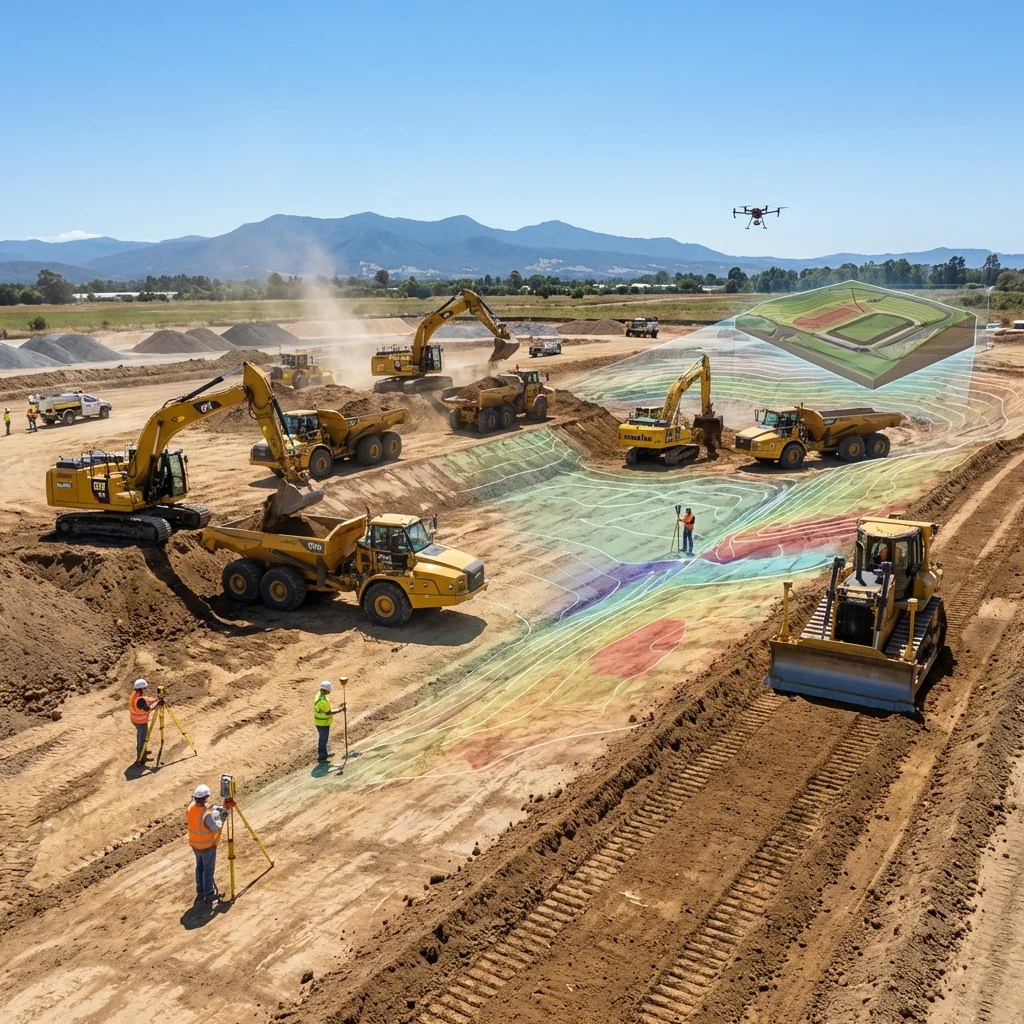
Earthwork Estimating Services
Precise cut and fill calculations, excavation takeoffs, grading estimates, and site clearing costs organized by CSI Division 31. Delivered in 24 to 48 hours.
Precise cut and fill calculations, excavation takeoffs, grading estimates, and site clearing costs organized by CSI Division 31. Delivered in 24 to 48 hours.
Earthwork is the first major cost on every construction project and the hardest to estimate accurately. Soil conditions, swell factors, haul distances, and equipment selection all affect your number before a single foundation wall is poured. A miscalculation in cut and fill volume can wipe out project profit before construction begins.
The Virtual Estimation provides professional earthwork estimating services for excavation subcontractors, site contractors, general contractors, and land developers across the USA and Canada. We calculate precise earth volumes using digital terrain models and plan-based takeoffs, price every scope item to your local equipment and material rates, and deliver complete CSI Division 31 earthwork estimates in 24 to 48 hours.
Earthwork estimates for single-family lots, custom homes, and residential subdivisions. We calculate foundation excavation volumes, basement and crawl space excavation, lot grading and finish grading, driveway subgrade preparation, retaining wall excavation, utility trench quantities, and landscaping rough grade. Spoil hauling distances and disposal costs estimated based on your site location.
Commercial earthwork estimates for office parks, retail centers, warehouses, industrial facilities, and mixed-use developments. We estimate mass grading volumes, cut and fill balance calculations, parking lot subgrade preparation, stormwater detention basin excavation, utility corridor trenching, and erosion and sediment control quantities. Large commercial sites are estimated by phase or construction zone where applicable.
Earthwork estimates for roads, highways, utility corridors, pipelines, and public infrastructure projects. We calculate roadway cut and fill quantities from profile grades, embankment volumes, borrow material requirements, subbase and base course quantities, and drainage structure excavation. All quantities organized per project stationing or bid schedule structure.
Large-scale earthwork estimates for industrial plants, distribution centers, mining support facilities, and heavy civil projects. We estimate mass excavation volumes, deep foundation pit excavation, shoring and dewatering allowances, compacted fill placement quantities, and haul road construction. Equipment productivity is modeled by material type and haul distance to produce defensible machine hour and cost estimates.
All earthwork estimates are organized per CSI MasterFormat Division 31 (Earthwork):
| CSI Division | Scope | What We Quantify | Key Variable |
|---|---|---|---|
| 31 10 00 | Site Clearing | Tree count by caliper, brush area (AC), stripping depth (CY) | Tree protection zone requirements |
| 31 11 00 | Clearing and Grubbing | Stripping volume (CY), stump count, root ball depth | Organic material disposal or on-site compost |
| 31 20 00 | Earth Moving | Cut volume (CY), fill volume (CY), haul distance (miles) | Swell and shrinkage factors by soil type |
| 31 22 00 | Grading | Rough grade area (SF/AC), finish grade tolerance, slopes | Drainage swale and berm formation |
| 31 23 00 | Excavation and Fill | Foundation pit dimensions (CY), compaction specs, lift thickness | Bearing capacity and geotechnical requirements |
| 31 23 16 | Trenching | Trench LF by width and depth, backfill type, compaction method | Shoring requirements over 4 ft depth |
| 31 25 00 | Erosion and Sedimentation Controls | Silt fence LF, inlet protection EA, stabilized entrance SF | NPDES permit compliance for disturbed area |
| 31 37 00 | Riprap | Riprap SF and depth, filter fabric, bedding gravel | Flow velocity and slope determining stone size |
Cut and fill balance is the most technically demanding part of earthwork estimating. An unbalanced site with excess cut material requires off-site spoil disposal. A site with insufficient fill requires borrow material import. Both carry significant cost consequences. We calculate net cut and fill volumes using the average end area method or prismoidal formula depending on terrain complexity, and apply soil-specific swell and shrinkage factors:
| Soil Type | Swell Factor | Typical Equipment | Cost Impact vs Loam |
|---|---|---|---|
| Sandy Loam (native) | 10 to 15% swell | Excavator, motor grader, compactor | Baseline |
| Clay (expansive) | 25 to 35% swell | Excavator, sheepsfoot roller | Add 15 to 25% |
| Gravel and Cobble | 5 to 8% swell | Rock excavator or hydraulic hammer | Add 10 to 20% |
| Solid Rock (ledge) | 30 to 50% swell | Drill and blast or rock hammer | Add 60 to 120% |
| Organic or Peat | Remove and replace | Excavator, dump truck | Add 20 to 40% plus import fill |
| Compacted Fill (import) | 0% swell, 10 to 15% shrinkage | Compactor, water truck | Borrow cost plus haul |
Every estimate we produce includes the following deliverables as standard:
Net cut and fill quantities in cubic yards calculated from your grading plan using the average end area method, with swell and shrinkage factors applied by soil type.
Mass excavation, foundation pit excavation, trench excavation, and subgrade preparation quantities measured and priced separately so you can verify each scope component.
Machine hours for excavators, bulldozers, motor graders, scrapers, compactors, and water trucks calculated from material volumes and site-specific productivity rates.
On-site spoil reuse balanced first. Excess cut material priced for off-site disposal including truck haul hours and tipping fees based on your project location.
Where fill volume exceeds cut, we estimate borrow material quantity, haul distance from available sources, and delivered cost per compacted cubic yard.
Compaction passes and lift thickness requirements per geotechnical specification. Testing allowances per ASTM D1557 or D698 by material type and compaction zone.
Tree and brush clearing area, stripping depth and volume, organic material disposal or stockpile quantities.
Silt fence, inlet protection, stabilized construction entrance, and temporary seeding quantities per NPDES permit requirements for your disturbed area.
Color-coded grading plans showing cut zones, fill zones, subgrade areas, and scope boundaries for field team reference.
Fully itemized cost breakdown by scope and CSI subdivision, sortable by quantity or cost, importable into your bid management system.
Written scope definition protecting your bid from disputes over what earthwork is and is not included.
We follow a structured workflow on every earthwork estimating engagement:
We review your civil site plan, grading plan, existing and proposed contour drawings, geotechnical report, and any survey data available. If no geotechnical report exists, we apply conservative soil assumptions appropriate to your region and clearly note the uncertainty.
Using the average end area method or grid method depending on terrain complexity, we calculate gross cut and fill volumes, apply soil swell and shrinkage factors, and determine the site balance. We flag import or export requirements before pricing begins.
All earthwork activities are separated by work type including clearing and grubbing, mass grading, excavation, trenching, erosion control, and compacted fill, so each scope item can be verified and priced independently.
Machine hours are estimated by material type and haul distance. Excavator cycle times, truck haul capacity, and compactor pass requirements are modeled using RS Means productivity data calibrated to your local conditions.
All quantities are priced using current RS Means regional equipment and labor rates for your zip code, supplemented with local hauling and disposal cost data.
A senior estimator independently verifies all volumes, productivity rates, and unit costs before delivery. Your complete earthwork estimate is delivered within 24 to 48 hours of receiving complete drawings.
| Tool or Standard | Application |
|---|---|
| PlanSwift and Bluebeam Revu | Digital takeoff of grading plan contours, site areas, and trench lengths from PDF and CAD drawings |
| RS Means Site Work and Landscape Cost Data | Regional equipment, labor, and material unit pricing updated quarterly |
| CSI MasterFormat Division 31 | Scope classification and estimate organization framework |
| Average End Area and Grid Methods | Volume calculation methods used depending on terrain complexity and drawing format |
| ASTM D1557 and D698 | Compaction testing standards referenced in compaction specification compliance allowances |
| NPDES General Permit Requirements | Erosion and sediment control scope basis for projects disturbing 1 acre or more |
| OSHA 29 CFR Part 1926 Subpart P | Excavation safety standards referenced for shoring allowances in deep trenching |
Earthwork estimating fees are based on site size, terrain complexity, scope, and required turnaround:
| Project Type | Fee Range | Turnaround | Rush |
|---|---|---|---|
| Residential lot grading and foundation excavation | $150 to $350 | 24 hrs | Same-day |
| Residential subdivision (up to 20 lots) | $400 to $900 | 24 to 48 hrs | Yes |
| Small commercial site (under 2 acres) | $300 to $700 | 24 to 48 hrs | Yes |
| Medium commercial site (2 to 10 acres) | $600 to $1,500 | 48 hrs | Case by case |
| Large commercial or industrial (10 to 50 acres) | $1,000 to $3,000+ | 48 to 72 hrs | Case by case |
| Heavy civil or highway earthwork | Custom quote | By scope | By scope |
First-time clients receive 30% off their first estimate. Volume pricing for contractors with multiple active projects.
Detailed cost evaluations for site tearing down, hauling, and prep.
Detailed estimates for foundations, slabs, and structural concrete work.
Comprehensive site utilities takeoffs for all project types.
Overall general building costs and context estimates.
Send us your grading plans and receive a complete CSI Division 31 earthwork estimate in 24 to 48 hours. First-time clients save 30%.
Questions about soil conditions, site balance, or turnaround? We respond within 2 business hours | info@thevirtualestimation.com